
Finding textiles that are both luxurious and truly safe for your family can feel like searching for a hidden gem. When comfort and style matter just as much as peace of mind, the right certifications become your first line of trust. Oeko-Tex stands apart as an independent certification system that confirms every robe, towel, or loungewear piece has passed rigorous testing for harmful substances, supporting your commitment to wellness, sustainability, and responsible shopping.
Table of Contents
- What Oeko-Tex Certification Means For Textiles
- Key Oeko-Tex Standards And Labels Explained
- What Products And Materials Qualify For Certification
- How Oeko-Tex Testing Works And What Is Checked
- Benefits For Families, Safety, And Sustainability
- Comparing Oeko-Tex With Other Textile Certifications
Key Takeaways
| Point | Details |
|---|---|
| Oeko-Tex Certification Ensures Safety | Oeko-Tex certification verifies that textiles are free from harmful substances, ensuring safety for you and your family. |
| Multiple Certification Types Available | Oeko-Tex offers various certifications, such as Standard 100 and Made in Green, focusing on different aspects of safety and sustainability. |
| Broad Applicability Across Products | The certification covers a wide array of textile products, from clothing to household textiles, ensuring safety throughout the supply chain. |
| Importance of Regular Testing | Oeko-Tex employs regular audits and testing to maintain standards, giving consumers ongoing assurance of product safety and ethical production practices. |
What Oeko-Tex Certification Means for Textiles
When you slip into a luxurious robe or wrap yourself in a plush towel, you’re probably not thinking about the 350+ harmful chemicals that could have been used during production. That’s where Oeko-Tex steps in. This independent certification system acts as your assurance that the textiles touching your skin have been rigorously tested and deemed safe from hazardous substances.
Oeko-Tex was established in 1992 and now operates across more than 70 countries with a global network of testing laboratories and auditing professionals. The certification isn’t just about the finished product either. It covers the entire supply chain, from raw materials through manufacturing to the final item sitting in your closet. This comprehensive approach means that every stage of production, from dyeing to finishing, has been evaluated for safety and environmental responsibility.
Here’s what makes this certification meaningful for your family’s spa and loungewear. Products receive testing against an extensive list of harmful substances and chemicals, and results are classified into four distinct categories based on how much skin contact the garment will have. A baby’s bodysuit gets stricter standards than a decorative cushion cover. This tiered classification system means the certification directly reflects how the product will actually be used in your home.
What genuinely matters is that Oeko-Tex certification goes beyond chemical safety. The organization also evaluates social and ecological factors throughout production, meaning workers were treated fairly and manufacturing practices didn’t devastate local environments. When you choose certified textiles, you’re supporting responsible production at every level.
The label on your robe or towel serves as proof that independent auditors have done the heavy lifting for you. Rather than trying to research every manufacturer’s practices yourself, you can trust that a product bearing this certification has met rigorous, internationally-recognized standards.
Pro tip: Look for the Oeko-Tex Standard 100 label specifically when shopping for loungewear and bath linens intended for direct skin contact, as this classification ensures the strictest safety requirements for items worn close to your body.
Key Oeko-Tex Standards and Labels Explained
Oeko-Tex isn’t just one checkbox on a label. The organization offers several distinct certification standards, each designed for different products and different priorities. Understanding which label matters most for your loungewear and bath linens helps you make smarter choices about what touches your skin.
Standard 100 is the most widely recognized Oeko-Tex certification you’ll encounter. This label focuses on product safety, testing textiles against harmful substances and chemicals that could irritate your skin or harm your health. Every component gets tested, from the fabric itself to the dyes, finishes, and even thread. The testing criteria update yearly to reflect new scientific findings about hazardous materials.
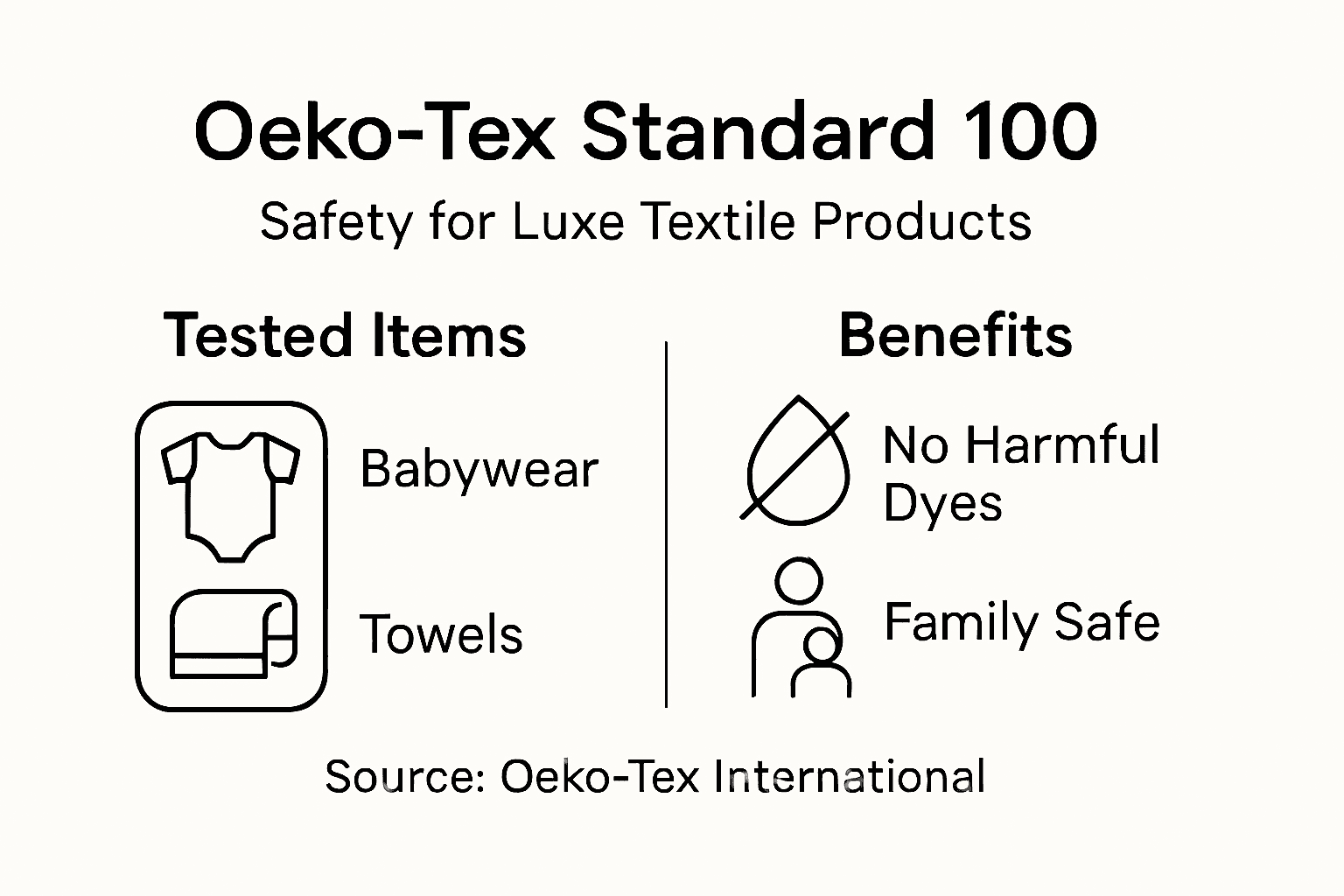
What makes Standard 100 especially relevant for you is its four-class system. Class 1 covers baby and young children’s clothing, with the strictest requirements. Class 2 is for items with extended skin contact, like your robes and sleepwear. Class 3 applies to garments with minimal contact, and Class 4 covers furnishing materials. Your loungewear typically falls into Class 2, meaning it meets rigorous safety standards specifically for items worn next to your body.
Beyond Standard 100, Oeko-Tex offers Made in Green, which goes further by evaluating environmental and social responsibility throughout the entire production supply chain. This certification confirms that workers were treated fairly and manufacturing practices aligned with environmental protections. STeP certification focuses specifically on sustainable textile production facilities. For those seeking products that reflect broader environmental values beyond just chemical safety, these labels tell a more complete story.
Oeko-Tex also provides Eco Passport for chemicals, which verifies that dyes and finishing chemicals used in production meet strict environmental and health standards. This matters because it addresses the beginning of the manufacturing process, not just the final product. When you see multiple Oeko-Tex labels on a single item, it signals comprehensive commitment to safety and responsibility at every stage.
Here’s how key Oeko-Tex certifications differ in scope and focus:
| Certification Type | Main Purpose | Applies To | Additional Benefit |
|---|---|---|---|
| Standard 100 | Chemical safety for finished textiles | All textile products | Annual criteria updates |
| Made in Green | Environmental & social responsibility | Entire supply chain | Traceable product labels |
| STeP | Sustainable facility certification | Manufacturing facilities | Audits for eco-friendly output |
| Eco Passport | Safe chemicals in production | Dyes and auxiliaries | Reduces hazardous substances |
Choosing among these certifications depends on what matters most to your family. For baseline safety, Standard 100 delivers. For comprehensive ethical and environmental responsibility, sustainable bath linen options with Made in Green or STeP certifications provide deeper assurance.
Pro tip: Check the certification class on the Oeko-Tex label itself when purchasing loungewear or robes to confirm the product was tested against safety standards appropriate for skin-contact items rather than furnishing materials.
What Products and Materials Qualify for Certification
Oeko-Tex certification isn’t limited to just clothing. The system covers a surprisingly broad range of textile and leather products that you encounter in your daily life, from the moment you wake up to when you settle in for the evening. This extensive scope means you have more options than you might realize when shopping for certified items.
The certification applies to finished products you purchase, but also to the individual components that go into making them. That means the raw fibers, yarns, and fabrics are tested before manufacturers even cut and sew your robe or towel. This input-stage testing catches potential problems early in production, ensuring safer materials from the very beginning. Dyes, finishes, and other chemicals applied during manufacturing also go through rigorous evaluation.
For your household, the most relevant certified products include clothing, household textiles like towels and bedding, and spa accessories. But Oeko-Tex also certifies children’s clothing and toys, which matters if you’re purchasing items for younger family members. Even leather products and automotive upholstery can carry certification, demonstrating the system’s reach across different industries and material types.
What’s particularly useful is understanding that certification covers the entire supply chain. A certified product doesn’t just mean the finished fabric passed testing. It means the facility that produced it met environmental and social standards, workers were treated fairly, and processes minimized waste and chemical runoff. This modularity of the certification system allows brands to demonstrate responsibility at every production stage.
When shopping for loungewear and bath linens, look beyond just the finished garment. Certified fibers and fabrics indicate that safety controls began long before the item reached your hands. Some manufacturers use certified materials but don’t pursue full product certification, so understanding what each label represents helps you identify truly comprehensive safety.
The beauty of this wide applicability is that building a completely certified household becomes achievable. Your robe, towels, bedding, and even children’s items can all carry the same trusted standard.
Pro tip: Check product tags for certification labels not just on finished robes and towels, but also note when fabrics themselves are certified, as this indicates safety controls began during fiber and yarn production stages.
How Oeko-Tex Testing Works and What Is Checked
Oeko-Tex testing isn’t a single quick check. It’s a multi-layered process that examines your textile from every conceivable angle, involving independent laboratories, on-site inspections, and continuous monitoring over years. Understanding what actually gets tested helps you appreciate why certification carries real weight.
The process begins with laboratory analysis of every component in your product. Your robe doesn’t just get tested as a whole garment. The fabric, buttons, zipper, thread, lining, and any other material gets analyzed separately. Tests specifically target harmful substances like azo dyes, formaldehyde, heavy metals, pesticides, and phthalates, chemicals known to cause skin irritation or health problems. This comprehensive component testing means nothing slips through unexamined.
Beyond the lab work, Oeko-Tex sends independent auditors to manufacturing facilities for on-site inspections. These aren’t announced in advance. Auditors review production documents, examine waste management practices, and verify that manufacturing processes actually comply with safety standards. They’re looking for evidence that the facility controls chemical use throughout production, not just at the testing stage.
Certification doesn’t happen once and then you’re done. Verification cycles repeat every two to three years with regular unannounced audits to ensure ongoing compliance. If a manufacturer fails any test or audit, corrective actions are required or certification gets suspended. This ongoing oversight keeps standards from becoming just a one-time checkbox.
The entire system operates through third-party verification, meaning independent organizations conduct the testing and auditing, not the manufacturers themselves. This independence is crucial because it removes conflicts of interest. A company can’t simply decide their product meets standards. External experts must verify it.
What gets checked covers the full production lifecycle. Water quality used in manufacturing, waste treatment, chemical storage, and worker safety protocols all factor into the assessment. For loungewear and bath items that touch your skin regularly, this thorough approach provides real assurance.
Pro tip: When purchasing certified items, check for the certification date on the label and verify it’s current within the two to three year renewal cycle, ensuring the product passed recent testing and auditing.
Benefits for Families, Safety, and Sustainability
Choosing Oeko-Tex certified textiles means more than just buying a nice robe. You’re making a deliberate decision to protect your family’s health while supporting manufacturing practices that respect both workers and the environment. The benefits ripple across multiple dimensions of your household.
For your family’s physical health, the advantage is straightforward. Certified products eliminate exposure to harmful substances commonly used in textile production, including chemicals linked to skin irritation, allergic reactions, and respiratory issues. This matters especially if anyone in your household has sensitive skin, eczema, or chemical sensitivities. You’re not just buying a loungewear piece; you’re investing in a product that won’t compromise your wellbeing during hours of daily wear.
Children and babies face particular vulnerability to textile chemicals because their skin barriers are still developing and more permeable than adults. Oeko-Tex certification provides specific protections for the youngest family members. When you select certified children’s clothing and bedding, you’re choosing products tested against the strictest safety standards available. This peace of mind is invaluable when it comes to your kids’ comfort and health.
Beyond personal safety, Oeko-Tex certification delivers environmental benefits that extend beyond your home. The certification process ensures that manufacturing practices incorporate environmental stewardship and fair labor standards, meaning water isn’t being contaminated, workers aren’t being exploited, and production facilities aren’t creating unnecessary waste. Annual retesting guarantees that manufacturers maintain these standards year after year, not just during an initial audit.
When you purchase certified items, you’re also supporting a market shift toward cleaner production. As more families demand safer textiles, manufacturers invest in better technologies and practices. Your purchasing power directly influences which companies thrive and which ones fall behind.
The sustainability aspect appeals to eco-conscious consumers who want their luxury purchases to align with their values. Certified items represent a tangible way to reduce your household’s environmental footprint while refusing to compromise on quality or comfort.
Pro tip: Build your family’s spa and loungewear collection gradually with certified items, starting with pieces worn closest to skin like robes and sleepwear, then expanding to bath linens and home textiles as your budget allows.
Comparing Oeko-Tex With Other Textile Certifications
Oeko-Tex isn’t the only certification system available for textiles, though its focus on finished product safety makes it particularly relevant for loungewear and bath linens. Understanding how it stacks up against other standards helps you decode product labels and make informed choices aligned with your priorities.
The most frequently compared certification is Global Organic Textile Standard (GOTS). While both emphasize safety and sustainability, they approach the problem differently. GOTS focuses on certifying that textiles are actually organic from fiber through finished product, verifying the organic integrity of materials throughout every production stage. Oeko-Tex, by contrast, doesn’t require organic materials but instead emphasizes rigorous testing for harmful substances and transparency throughout the supply chain.
Think of it this way: GOTS answers the question “Is this made from organic cotton?” while Oeko-Tex answers “Is this free from dangerous chemicals regardless of fiber type?” A product can be certified organic under GOTS but still carry chemical residues from processing. Conversely, a synthetic material could pass Oeko-Tex testing because it’s been properly treated, even though it’s not organic.
GOTS requires certification across all processing stages, which is more comprehensive in scope but also more restrictive. You’re essentially getting a complete chain of custody verification. Oeko-Tex operates as a modular system, meaning brands can pursue different certification levels depending on their priorities and products.
Other certifications like Fair Trade Certified or Bluesign focus on specific aspects. Fair Trade emphasizes labor practices and worker compensation. Bluesign targets chemical management during manufacturing. The reality is that many premium brands now pursue multiple certifications simultaneously because each one covers different ground.
Here’s a practical comparison of Oeko-Tex and major textile certifications for families:
| Certification | Focus Area | Organic Requirement | Best For |
|---|---|---|---|
| Oeko-Tex Standard 100 | Chemical safety | Not required | Sensitive skin, daily wear |
| GOTS | Organic sourcing | Required | Eco-conscious consumers |
| Bluesign | Chemical management | Not required | Factory-level sustainability |
| Fair Trade Certified | Labor practices | Not required | Ethical working conditions |
For your family’s needs, Oeko-Tex Standard 100 provides the most direct assurance that finished items touching your skin are chemically safe. If organic sourcing matters equally to you, look for products carrying both certifications. The combination gives you complete coverage.
Pro tip: Don’t assume one certification covers everything; check product labels for multiple certifications that together address chemical safety, organic status, and fair labor practices based on what matters most to your family.
Experience True Comfort with Certified Safe Textiles
The challenge of safeguarding your family’s health while enjoying luxurious bath and loungewear is real. Harmful chemicals hidden in everyday fabrics can cause skin irritation and affect well-being especially for sensitive skin or children. At Lotus Linen, we understand the importance of Oeko-Tex Standard 100 certification which guarantees textiles free from hazardous substances and made with rigorous safety and environmental standards. Our collection of plush robes and towels is crafted to meet these strict demands so you can relax with confidence every day.

Discover the perfect blend of comfort, safety, and elegance by exploring our range of customizable robes and spa accessories. Don’t wait to protect your loved ones with textiles tested for chemical safety and manufactured responsibly. Begin your journey to a safer, more luxurious home by visiting Lotus Linen today and choose products designed with your family’s health and comfort in mind.
Frequently Asked Questions
What does Oeko-Tex certification mean for textiles?
Oeko-Tex certification signifies that textiles have been rigorously tested for harmful substances and deemed safe for human contact. It covers the entire supply chain, ensuring safety from raw materials to finished products.
How does Oeko-Tex Standard 100 classification work?
Oeko-Tex Standard 100 classifies products into four categories based on the level of skin contact. Class 1 is for baby items with the strictest safety requirements, while Class 2 is for items like loungewear that have extended skin contact. Class 3 applies to garments with minimal skin contact, and Class 4 is for furnishing materials.
What types of products can receive Oeko-Tex certification?
Oeko-Tex certification can apply to a wide range of textile and leather products, including clothing, household textiles like towels and bedding, children’s clothing and toys, and even automotive upholstery, ensuring safety at every production stage.
How does the Oeko-Tex testing process work?
The Oeko-Tex testing process involves laboratory analysis of every component in the product, including fabrics, dyes, and threads. Independent auditors conduct on-site inspections to verify compliance, and manufacturers undergo regular audits every two to three years to maintain certification.

