TL;DR:
- True plush towels combine high GSM, fiber quality, and construction for consistent softness and thickness.
- Balance of plushness and absorbency depends on GSM, pile length, fiber type, and weave; longer drying time may occur.
- Proper care, including gentle washing and avoiding fabric softeners, preserves plush towels’ softness and longevity.
Most people reach for the softest towel on the shelf, wrap it around themselves once in the store aisle, and call that research. But that single touch test misses almost everything that matters about long-term luxury. A towel can feel like a cloud on first contact and turn into a scratchy disappointment after three washes. Understanding what “plush” actually means gives you the power to choose a towel that delivers comfort every single day, not just on the first use.
Table of Contents
- What does ‘plush’ mean in towels?
- Plushness vs. absorbency: Finding the sweet spot
- How plush towels are made: Materials and construction
- Caring for plush towels to preserve softness and luxury
- What most people miss about plush towels
- Ready to upgrade your home spa experience?
- Frequently asked questions
Key Takeaways
| Point | Details |
|---|---|
| Plushness defined | A plush towel is a soft, dense towel with a high GSM that provides a luxurious feel. |
| Balance matters | The best plush towels combine comfort and absorbency but may need extra drying time. |
| Material choices | Long-staple cotton and precise weaving create optimal plushness and lasting softness. |
| Proper care | Careful laundering and storage help maintain plushness, avoiding fabric softener buildup. |
What does ‘plush’ mean in towels?
True plushness is not just a feeling. It is a combination of construction choices, fiber quality, and finishing techniques that work together to create a towel that feels thick, soft, and indulgent every time you use it.
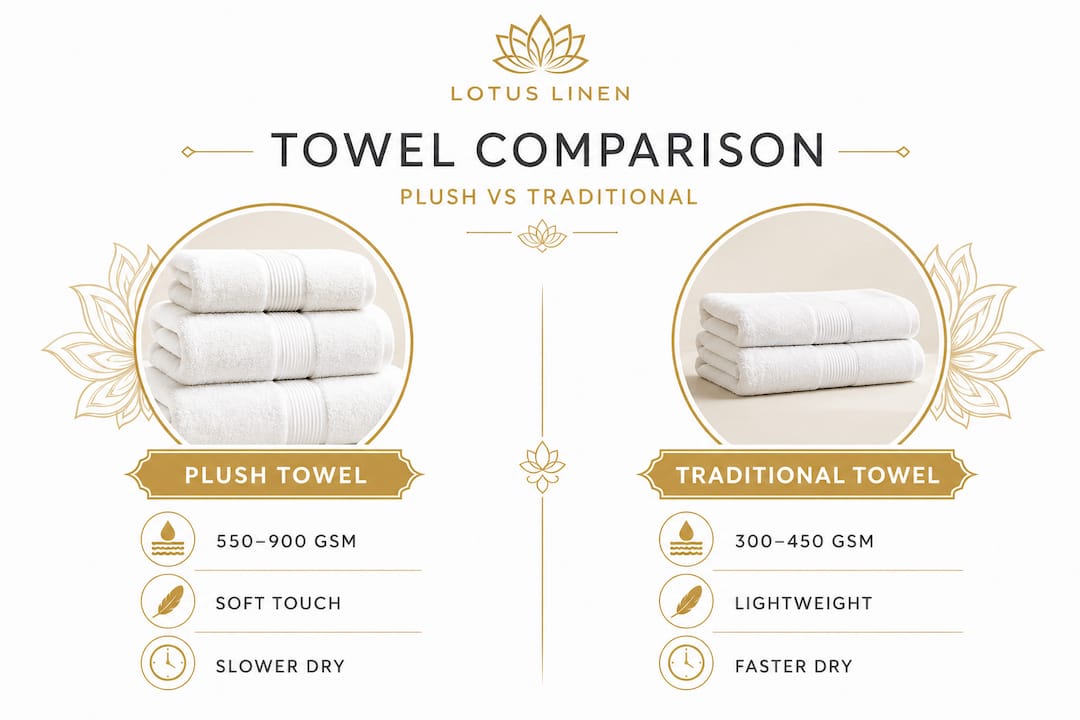
The most important measurement to know is GSM, which stands for grams per square meter. GSM tells you how much fabric is packed into each square meter of the towel. A higher GSM means more material, more pile, and a denser weave. Most everyday towels land between 300 and 400 GSM. A genuinely plush towel typically starts at 550 GSM and can go up to 900 GSM for the most luxurious options. When you pick up a plush towel and feel that satisfying weight, that is GSM doing its job.
But GSM alone does not tell the whole story. Pile length, which is the height of the loops on the towel’s surface, plays an equally important role. Long loops create that classic fluffy appearance and a softer feel against skin. Yarn type matters just as much. Combed cotton, for example, removes short fibers before weaving, leaving only the longest, smoothest strands. The result is a denser, more uniform surface that holds its softness wash after wash.
Here is where many shoppers get tripped up:
- A soft towel is not automatically a plush towel. Some manufacturers use chemical softeners or silicone coatings to make towels feel silky in packaging. That feeling disappears quickly once the coating washes out.
- A plush towel is not automatically absorbent. Dense construction can slow moisture wicking if the yarn type is not chosen carefully.
- Pile length without fiber quality produces fluff without function. The loops may look full but compress and mat down after minimal use.
Consumer testing shows that plush towels are evaluated on absorbency and drying time together, because plushness can trade off with longer drying. Real plushness earns high marks across all three categories, not just feel.
A smart shopper reads beyond the label. If a towel is marketed as “ultra plush” but the GSM is not listed, that is a red flag. Brands that are confident in their construction share those numbers. You can also explore plushness vs absorbency to better understand how these factors connect before you buy, or check out a detailed towel fabric comparison to see how different materials stack up.
Plushness vs. absorbency: Finding the sweet spot
A plush towel that cannot dry you off properly is just a decorative object. The relationship between plushness and absorbency is one of the most misunderstood aspects of towel shopping, and getting it right separates a good towel from a great one.
Plush towels excel at comfort because their dense loops create a large surface area that contacts your skin. That same density, however, means more material to saturate. A very dense, high-GSM towel can take longer to air dry and machine dry, even when it scores highly for absorbency and feel. That is not necessarily a dealbreaker, but it is a real trade-off to plan for.
Here are the signs that a towel has found the right balance:
- It absorbs moisture quickly on first contact, without needing to be pressed firmly against skin.
- It feels dry to the touch between uses after hanging for a few hours.
- The pile bounces back after wringing instead of staying compressed.
- The weight feels substantial but not waterlogged after use.
- It maintains softness and absorbency through repeated washing without significant change.
There is also a less obvious issue worth knowing. A towel can feel “soft” but still underperform for drying comfort if the fibers are coated or if residue remains from fabric softener. That waxy coating blocks moisture absorption at the fiber level. You wrap yourself up, the towel feels nice, but you are still damp two minutes later.
| Feature | Plush towel | Traditional towel |
|---|---|---|
| GSM range | 550 to 900 | 300 to 450 |
| Hand-feel | Very soft, cushioned | Functional, firm |
| Absorbency | High, slightly slower uptake | Moderate, faster uptake |
| Drying time (towel) | Longer | Shorter |
| Lifespan with care | Long | Moderate |
| Best use | Spa, home luxury, gifting | Everyday, gym, travel |

When comparing softness and absorbency, keep this table in mind as a starting framework, then adjust based on your lifestyle. If you hang towels outdoors or in a well-ventilated bathroom, the longer drying time for plush towels becomes far less of a concern. If you are shopping for best towel materials that maximize both qualities, look for combed or ring-spun cotton at 600 to 700 GSM.
Pro Tip: To test absorbency at home before buying in bulk, wet your forearm and press the towel firmly against the skin for three seconds. A well-balanced plush towel will visibly wick moisture without needing multiple swipes. If the surface beads water instead of pulling it in, pass on that towel.
How plush towels are made: Materials and construction
The materials and construction methods behind a plush towel determine everything from its first touch to how it performs five years from now. Knowing what to look for makes the difference between buying on impulse and buying with confidence.
Cotton varieties dominate the premium towel space for good reason. Egyptian cotton is grown in the Nile River region and produces extra-long staple fibers, meaning each individual fiber strand is unusually long. Longer fibers create smoother, stronger yarns that are less likely to pill or mat. Turkish cotton, from the Aegean region, is similarly long-staple and is particularly well-regarded for its fast absorption and soft finish that improves with every wash. Pima cotton, grown primarily in the American Southwest and Peru, offers comparable quality at a slightly more accessible price point.

Bamboo blends have become a popular choice for people with sensitive skin. Bamboo fibers are naturally smooth and do not have the surface barbs found in some cotton varieties. A bamboo and cotton blend often delivers a silky surface feel while retaining the structural integrity that pure bamboo sometimes lacks on its own.
| Material | Softness | Absorbency | Durability | Drying time |
|---|---|---|---|---|
| Egyptian cotton | Excellent | Excellent | Excellent | Moderate |
| Turkish cotton | Very good | Excellent | Very good | Fast |
| Pima cotton | Very good | Very good | Good | Moderate |
| Bamboo blend | Excellent | Good | Moderate | Fast |
| Microfiber | Good | Very good | Good | Very fast |
Weave types shape the final texture and performance of the towel:
- Terry weave is the standard for bath towels. Loops on both sides create a highly absorbent, textured surface that holds up well to repeated washing.
- Velour cuts the loops on one side to create a velvety, smooth surface. These towels look polished and feel very soft against skin but are slightly less absorbent than terry.
- Zero twist yarn construction removes the tight twisting of fibers during spinning. This creates a softer, more open fiber structure that feels plush immediately and absorbs quickly. The trade-off is that zero twist towels are more delicate under heavy use.
Consumer testing consistently evaluates these variables together because no single factor determines quality in isolation. When choosing plush towels, match the weave type to your priorities. Terry for everyday absorbency, velour for a spa aesthetic, zero twist for the softest possible feel. For a side-by-side breakdown of how fabrics compare across all these categories, the luxury towel materials guide goes deep on each option.
Caring for plush towels to preserve softness and luxury
Buying the right plush towel is only half the equation. How you care for it determines whether it stays luxurious for years or turns rough and flat within months.
The single most common mistake people make is overusing fabric softener. It feels counterintuitive because softener sounds like it should help. But fabric softener works by coating fibers with a thin waxy layer. That coating builds up over time and prevents the fibers from doing their job. Reputable guides emphasize that a towel can feel “soft” but still underperform because of fiber coating from softener residue. Skip it entirely or use it only once every five to six washes at most.
Follow these steps to keep your plush towels in peak condition:
- Wash before first use. New towels often have a finishing treatment from the factory. One wash removes it and activates full absorbency.
- Use a gentle, low-fragrance detergent. Heavy detergents leave residue that accumulates in the fibers over time.
- Wash in warm water, not hot. High heat breaks down the fiber structure faster and can cause shrinkage in long-staple cotton towels.
- Avoid overfilling the machine. Plush towels need room to agitate freely. Cramming too many in causes tangling and uneven wear.
- Tumble dry on low heat. High heat damages the loops and causes them to flatten. Low and slow preserves the pile height.
- Do not over-dry. Remove towels while they are still very slightly damp and allow them to finish air drying. Over-drying stiffens fibers noticeably.
- Store loosely folded in a dry space. Tight storage or damp environments compress the pile and encourage mildew.
Detailed towel care instructions walk through each of these steps in greater depth if you want to go further. For towels that have already lost some of their original softness, the maintaining towel softness guide covers practical restoration techniques.
Pro Tip: To revive a plush towel that has gone stiff or flat, wash it once with one cup of white vinegar instead of detergent, then wash again with a small amount of baking soda. No fabric softener. Dry on low. This strips the residue and opens the fibers back up. Most towels come out noticeably softer after just one cycle of this treatment.
What most people miss about plush towels
Here is the uncomfortable truth about towel shopping: most buyers optimize for the wrong moment. They evaluate a towel in the store or immediately after opening the package, when the towel is at its most impressive and least representative of long-term performance.
First impressions in the towel world are extremely easy to engineer. A thick, chemically softened towel with a fluffy appearance and a luxury-sounding label can fool almost anyone in a 30-second touch test. What that test cannot reveal is how the towel performs after 30 washes, or whether the softness was in the fiber or in the coating.
Real plushness is structural, not cosmetic. It lives in the length and quality of the staple fiber, in the GSM, in the precision of the loop construction, and in the weave technique used. These are things you cannot feel in a single grab. They reveal themselves over months of use and dozens of wash cycles.
We have also learned that the buyers who are most satisfied long-term are the ones who think about care before they buy. Choosing a high-quality plush towel and then washing it with hot water and heavy softener every week is like buying a great mattress and never using a mattress protector. The investment makes no sense without the follow-through.
A towel can feel “soft” at first but consistently underperform for drying comfort when fibers are coated or compromised. That gap between perception and reality is where most towel disappointment lives. The buyers who understand this shift their focus from first touch to long-term texture and choose towels for comfort that is built to last, not just to impress at first contact.
The most luxurious towel is not necessarily the heaviest or the most expensive. It is the one that has been thoughtfully constructed, honestly described, and properly cared for over time.
Ready to upgrade your home spa experience?
Inspired to find your own plush comfort? At Lotus Linen, we design every towel with the qualities that actually matter: verified GSM ratings, premium long-staple cotton, and construction methods that deliver softness through years of washing.

Our luxury plush towels are available in a range of sizes and colorways to match your bathroom aesthetic perfectly. Pair them with one of our spa-quality robes to create the full at-home spa experience your self-care routine deserves. Whether you are shopping for yourself or looking for a gift that genuinely impresses, Lotus Linen gives you the real thing, not just the appearance of luxury. Explore our full bath collection and feel the difference that intentional construction makes.
Frequently asked questions
Do plush towels dry as well as regular towels?
Plush towels can be just as absorbent as standard options, but their dense construction means they may take longer to dry out between uses. Consumer testing confirms that plushness and drying time are often a trade-off, so hanging them in a well-ventilated space matters.
What is the best material for a plush towel?
Turkish and Egyptian cotton are the top choices for plush towels because their extra-long staple fibers produce a soft, durable weave that actually improves with washing. Bamboo blends are a strong alternative for anyone with sensitive skin.
How can I keep plush towels soft after washing?
Use a gentle detergent, wash in warm rather than hot water, and tumble dry on a low setting. Skip fabric softener regularly, since fiber coating from softener reduces absorbency over time even when the towel still feels soft to the touch.
Do plush towels shed lint more than others?
New plush towels shed some lint during the first few washes because loose surface fibers work their way out of the weave. This decreases significantly after two to three washes and stops almost entirely once the towel is broken in properly, especially if made with quality long-staple yarn.
Recommended
- Towel Softness Maintenance: Care Tips – Lotus Linen
- Understanding Towel Material Comparison for Luxury Comfort – Lotus Linen
- How to Choose Towels for Luxurious Comfort at Home – Lotus Linen
- Luxury Towel Features Explained: The 2025 Owner’s Guide – Lotus Linen
- Travel Towels Explained: Smarter Packing for Outdoors – Sitpack