
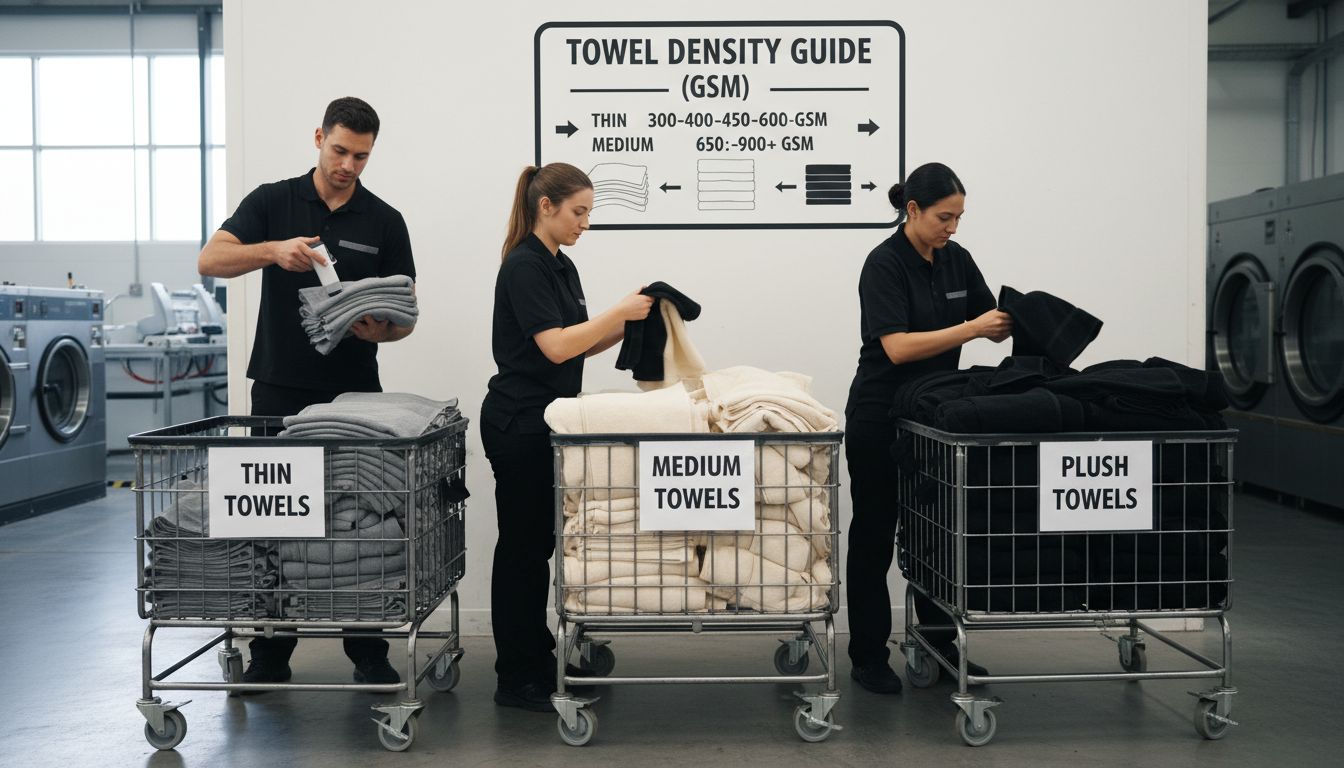
Pick up two bath towels of the same size and one can feel twice as substantial as the other. The reason is GSM — grams per square meter — the single number that describes how dense a towel is, and the best shorthand for how thick, absorbent, and plush it will feel. This guide decodes what those GSM numbers mean, what weight suits which use, and why the number alone doesn't tell the whole story.
What GSM actually measures
GSM stands for grams per square meter — the weight of the towel's fabric across a fixed area. A higher GSM means more cotton packed into the same space: denser loops, a heavier hand, and usually more water held per towel. It is a density measurement, not a quality grade — a well-made lighter towel can outperform a poorly made heavier one — but as a first read on how a towel will feel, GSM is the most useful number on the label.
Common GSM ranges you may see when shopping
| GSM range | Feel | Behavior | Often chosen for |
|---|---|---|---|
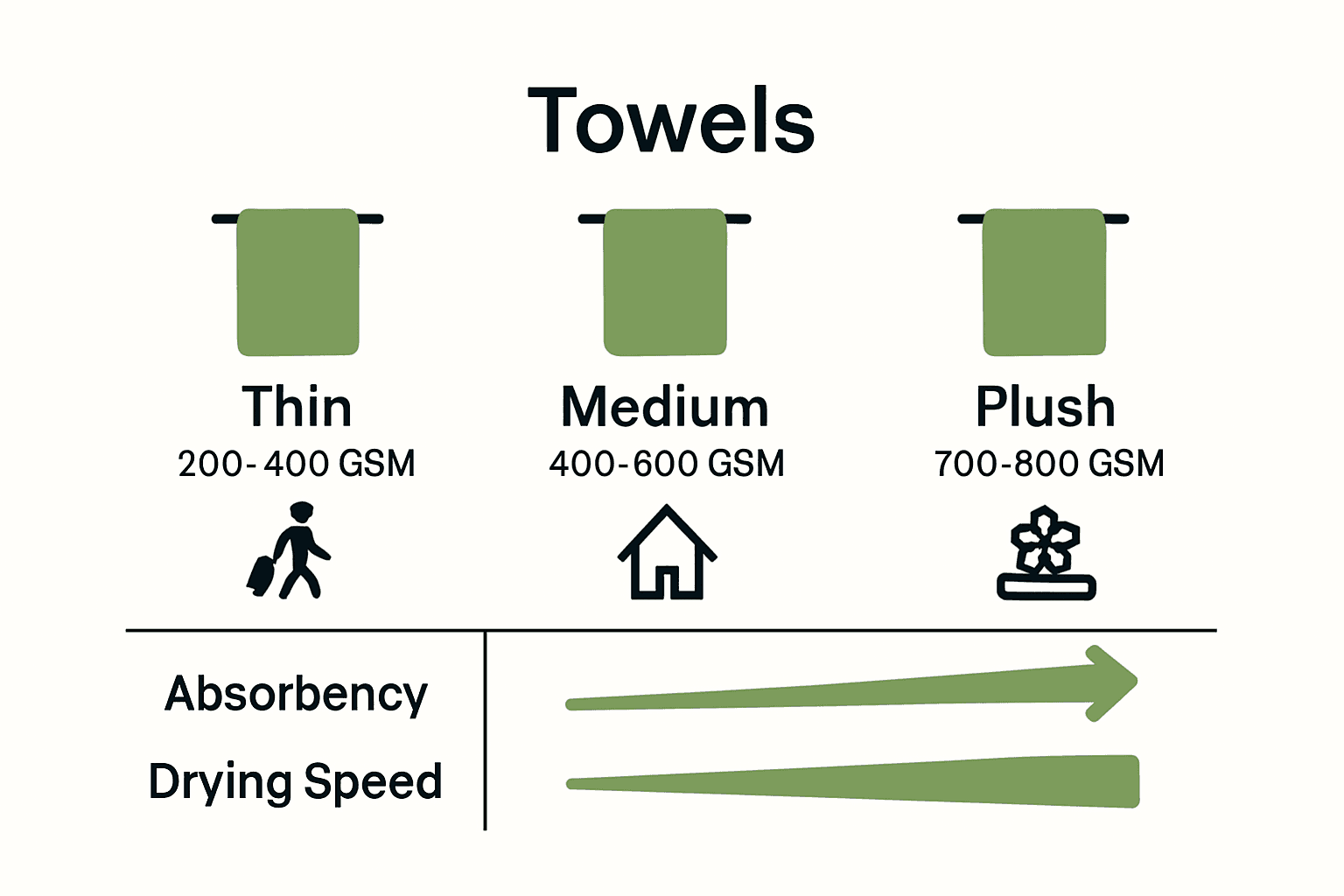
| 300–400 (lightweight) | Thin, flat | Dries quickly, packs small, less absorbent | Gym, travel, quick-dry |
| 400–600 (everyday) | Soft, medium weight | Balanced absorbency and drying time | Daily home use, families |
| 600–900 (plush / spa) | Dense, substantial | Very absorbent, heavier, slower to dry | A hotel-style, indulgent feel |
These ranges are general shopping guidelines rather than universal quality grades; construction can make two towels with similar GSM feel and perform very differently.
So "450 GSM" describes a light-to-medium everyday towel, and "600 vs 800 GSM" is really a trade-off between a lighter feel and a plusher, heavier one — which we cover in detail below.
Why GSM isn't the whole story
Two towels at the same GSM can feel completely different, because weight is only one variable. The others:
- Yarn construction. How the cotton is spun matters as much as how much of it there is. Zero-twist cotton, for example, is spun with little to no twist so each loop opens fully, which contributes to a softer, more open feel at a given weight.
- Weave and pile structure. Longer, denser loops hold more water; a tighter ground weave adds durability.
- Fiber quality and finishing. The cotton itself and how a towel is finished at the mill affect softness and how it wears over time.
A well-constructed 620 GSM zero-twist towel can feel exceptionally plush without relying on extreme fabric weight. GSM is only one part of the experience; yarn construction, pile structure, and fiber quality also affect softness, absorbency, and drying behavior.
Which weight for which use
| Use | What to look for |
|---|---|
| Everyday bath towels | A substantial mid-to-high weight that still dries between showers — the 500–700 range suits most homes |
| Guest bath / hand towels | The same weight as your bath towels for a coordinated look; thickness matters less on smaller pieces |
| Travel / gym | Lighter and faster-drying (300–450) so it packs down and doesn't stay damp |
| Hotel / spa feel at home | A denser, plush weight — accepting that it will be heavier and dry a little slower |
| Bath mats | A much heavier construction than towels, because a mat's job is different — dense cushioning underfoot rather than quick drying |
Common GSM questions, answered
Is 450 GSM good for a towel?
Yes, for the right purpose. 450 GSM is a light-to-medium everyday weight — soft, quick to dry, and easy to launder. It's a sensible choice for gym and travel towels, kids' towels, or anyone who prefers a lighter towel that dries fast. If you want a plush, spa-like hand, you'll likely prefer something denser.
Is 600 GSM good for bath towels?
It's a strong everyday-to-premium weight for bath towels — substantial and absorbent while still drying between uses. Combined with good construction, a towel around this weight feels plush without becoming heavy or slow to dry. It sits right in the sweet spot most homes are happiest with.
600 GSM vs. 800 GSM: what's the difference?
Both are plush weights; the difference is a trade-off. A 600 GSM towel is lighter, easier to handle, and dries a bit sooner. An 800 GSM towel feels denser and more indulgent and holds more water, but it's heavier and takes longer to dry. Neither is "better" on its own — and because construction matters as much as weight, a well-made 600 GSM towel can feel plusher than a cheaply made 800 GSM one.
Common mistakes when choosing by thickness
- Assuming higher GSM always means better. Past a point, extra weight mainly adds bulk and drying time. Construction and yarn quality matter more than a bigger number.
- Ignoring how the towel will be used. A plush, heavy towel is wonderful on a heated rail and frustrating in a gym bag.
- Reading GSM in isolation. Always weigh it against the yarn and weave — a mid-weight, well-constructed towel often beats a heavier, cheaply made one.
Why Lotus Linen uses 620 GSM zero-twist cotton
We chose 620 GSM deliberately: it gives our towels a substantial, lofty softness without unnecessary heaviness, so they feel plush on the rail but stay easy to live with and launder. Pairing that weight with zero-twist construction — where the loops are spun with little to no twist and open up fully — is what gives the towels their soft, open hand. It's a balance of weight and construction rather than a chase for the highest possible number.
Different products call for different weights, though. Our bath mats use a much heavier 1000 GSM construction — not because heavier is inherently better, but because a mat's job is to cushion underfoot, which is a different need from a towel's. You can feel the difference across the full scalloped towel collection — from the bath towels and oversized bath sheets to matching hand towels.


