
Towel density can quietly make or break the experience your spa guests expect. Many operators assume thicker towels are always better, but weight alone is not the whole story — softness, absorbency, and how the towel performs through your laundry cycle matter just as much. This guide covers what density actually measures, how it shapes guest comfort and daily operations, and how to choose a density that feels indulgent in the guest's hands while running smoothly behind the scenes. For a consumer-focused breakdown of GSM ranges, see our towel thickness comparison guide; here the focus is the spa and hospitality context.
Table of Contents
- Towel density defined, and common misconceptions
- How density affects comfort and absorbency
- Density and your operations
- Density, customization, and guest impressions
- What to avoid when selecting density
Key takeaways
| Point | Details |
|---|---|
| Density is measured in GSM | Grams per square meter describes how much fiber is packed into the fabric, which affects feel, absorbency, and durability. |
| Higher isn't automatically better | Very heavy towels can absorb more slowly and take longer to dry, which creates operational friction. |
| A mid-to-high range is the sweet spot | It balances a plush, substantial feel with manageable drying times for daily turnover. |
| Density interacts with branding | A firm, substantial towel gives embroidery a crisp base and reads as premium in the hand. |
Towel Density Defined, and Common Misconceptions
Towel density measures how much fiber is packed into a given area of fabric, expressed in grams per square meter (GSM). A higher GSM generally means a thicker, heavier, more substantial towel; a lower GSM means a lighter, thinner one. Think of it as the towel equivalent of thread count in sheets, except GSM captures a towel's actual substance more directly.
The most common misconception is that higher density always means better quality. It doesn't. Density works alongside the weave and the fiber to determine a towel's real performance — its softness, absorbency, and durability. Guest preference varies, too: some guests love a plush, substantial towel, while others prefer a lighter one that dries faster. Neither is objectively "better." Your spa's positioning and operations determine which is right.
It also helps to know that density shifts slightly with use. Towels compress and settle over their first several washes, so a new towel's hand feel changes a little as it breaks in — normal, and worth accounting for when you evaluate samples.
How Density Affects Comfort and Absorbency
Absorbency depends on how water moves through the towel's structure, and density influences that in both directions. A heavier towel can hold more total water, but it may also absorb it more slowly and take longer to dry than a lighter one. That is why a mid-to-high density in quality cotton tends to be the sweet spot for spas: it absorbs efficiently and feels substantial, while still drying within a reasonable window between guest uses.
There is a genuine trade-off between plushness and practicality. Denser towels feel luxurious and hold up well, but push the density too high and you get long drying times and a towel that can feel heavy and cumbersome when wrapped around wet hair or shoulders. The goal is a towel that feels pampering without becoming a burden — for the guest or for your laundry team.
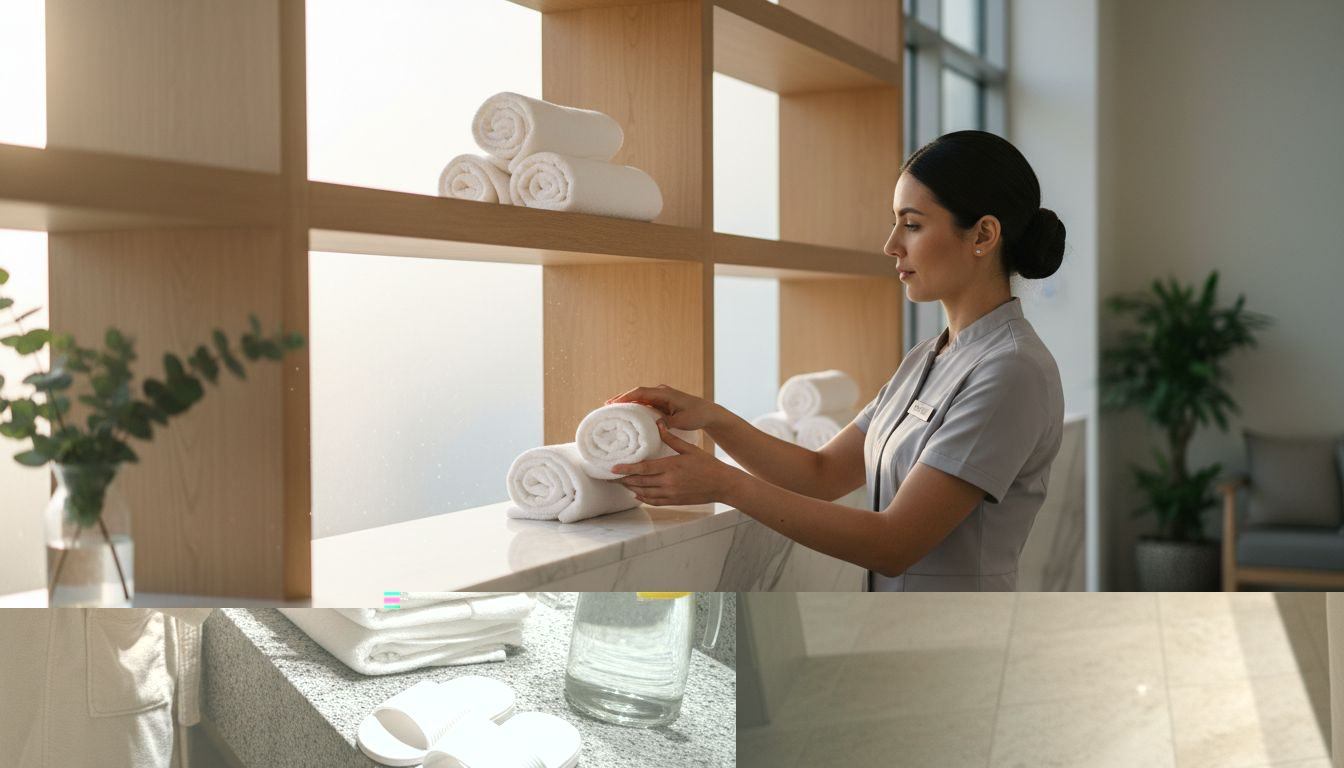
Lotus Linen towels are woven from 100% zero-twist cotton at 620 GSM, which sits squarely in that mid-to-high sweet spot — plush and absorbent in the hand, yet still practical to launder and dry at spa volumes. The zero-twist construction keeps the surface soft while maintaining the substance guests associate with a premium towel.
Density and Your Operations
The right density for your spa depends as much on your operation as on guest preference. A few factors to weigh:
| Density range | Feel | Drying & turnover |
|---|---|---|
| Lower GSM | Light, quick to soften | Dries fast; better for very high turnover, less substantial in hand |
| Mid-to-high GSM | Plush and substantial | Balanced drying; the practical luxury choice for most spas |
| Very high GSM | Maximum plushness | Slow to dry; can strain turnover and energy use |
Climate and laundry capacity matter, too. In humid environments, a very heavy towel may never fully dry between uses, inviting odors, so a moderate density is safer. High-turnover spas doing daily washing also benefit from a density that dries quickly, while a property with more laundry headroom can sustain a heavier towel. Match density to your actual drying capacity, not just the marketing appeal of a big number.
Pro tip: Before committing to a bulk order, run a small sample batch through several complete wash-and-dry cycles on your real equipment. Check how the towel feels after break-in and how long it takes to dry in your space — those two observations tell you more than the spec sheet.
Density, Customization, and Guest Impressions
Density also shapes how your branding looks and lasts. A firmer, more substantial towel gives embroidery a crisp base, so a monogram or logo stands out cleanly against the fabric. On a very thin towel, embroidery sits flatter and reads as less defined, which can undercut the investment in custom branding.
First impressions are tactile. When a guest picks up a substantial, well-made towel, they register quality before they even use it, and they connect that feeling to your facility overall. Rolled, monogrammed towels in a curated bathroom hold their shape and photograph well, and guests who share those images do a little marketing for you. A more substantial towel simply presents better — in the hand and on camera.
Lotus Linen adds names, initials, and logos with in-house embroidery at our Orange County, California workshop, so a spa's branding is applied cleanly on cotton that gives it a firm, lasting base.
What to Avoid When Selecting Density
Most density mistakes come from chasing a number instead of matching the towel to your operation:
- Going too heavy without testing drying. An extremely dense towel can take a long time to dry, driving up energy costs and inviting mildew in humid rooms. Confirm drying logistics before ordering.
- Going too light to save money. Very thin towels wear and thin out quickly, and guest perception drops when a towel feels flimsy — especially once it is branded.
- Ignoring your environment. Humidity and laundry capacity should drive the decision. What works in a dry climate with industrial dryers may not work in a humid coastal spa with in-house machines. Understanding how humidity affects linens helps you avoid selecting towels that never fully dry.
- Copying competitors. Your location, humidity, and laundry systems are unique. Choose density for your operation, not someone else's.
Density tells you what's in the towel; how it performs in your space tells you whether it's the right choice.
Choose a density that feels — and works — like luxury
Choosing towel density is more than a numbers game. It shapes guest comfort, absorbency, drying time, and how your branding presents. The practical sweet spot for most spas is a mid-to-high GSM in quality cotton — plush enough to impress, efficient enough to run daily. Lotus Linen's 100% zero-twist cotton towels at 620 GSM are built for exactly that balance, and they can be embroidered in-house for your property.

Explore our luxury bath towel sets or, for volume and consistent spec sheets across your property, our wholesale program. Request samples to feel the density in your own space before you commit.
Frequently asked questions
What is towel density and how is it measured?
Towel density measures how much fiber is packed into a given area of fabric, expressed in grams per square meter (GSM). Higher GSM means a thicker, heavier towel; lower GSM means a lighter, thinner one.
How does density affect absorbency and comfort?
Density influences how much water a towel holds and how it feels against the skin. A mid-to-high density in quality cotton tends to absorb efficiently and feel substantial while still drying in a reasonable time — Lotus Linen towels sit in that range at 620 GSM.
Are higher density towels always better for luxury spas?
Not necessarily. Beyond a point, very high density slows drying and can feel heavy without improving the guest experience. Softness, absorbency, and drying time matter as much as raw weight.
What density should a spa choose?
A mid-to-high GSM in quality cotton is the practical sweet spot for most spas — plush and substantial, yet efficient to launder and dry at volume. Match the final choice to your climate and laundry capacity.

