
TL;DR:
- Temperature regulation in robes depends on fabric structure and moisture management, not weight alone.
- Choosing breathable, moisture-wicking fabrics like waffle weave, bamboo, or merino wool enhances comfort across climates.
Most people buy a robe the same way they buy a blanket: the heavier and fluffier, the warmer and better. That logic fails the moment you step out of a steamy shower, sit in a warm bedroom, or try to sleep in one. Temperature regulation in robes is not about weight. It’s about how a fabric manages heat, moisture, and airflow against your skin. This guide covers the science behind your body’s cooling and warming needs, breaks down which materials and weaves actually work, and explains how cutting-edge textile technology is changing what a robe can do for your comfort.
Table of Contents
- Key Takeaways
- How temperature regulation in robes actually works
- Robe fabrics and weaves: what separates warm from clammy
- Innovations in robe textiles you should know about
- How to choose the right robe for your climate
- Keeping your robe’s performance intact
- My honest take on robe selection
- The right robe for your thermal comfort, from Shoplotuslinen
- FAQ
Key Takeaways
| Point | Details |
|---|---|
| Fabric beats weight | A lighter waffle weave robe often outperforms a heavy terry cloth robe in overall thermal comfort. |
| Breathability is non-negotiable | Fabrics that allow moisture to evaporate keep your body’s cooling system working efficiently. |
| GSM matters for drying | Robes above 600 GSM stay damp far longer and can trap heat uncomfortably against the skin. |
| Advanced coatings exist | Nanoparticle-coated textiles can reduce perceived temperature by several degrees under sunlight. |
| Context drives selection | Room temperature, humidity, and activity level should determine which robe you reach for. |
How temperature regulation in robes actually works
Your body maintains a core temperature of roughly 98.6°F through a feedback loop managed by the hypothalamus. When you get too warm, your nervous system signals sweat glands to produce moisture, which evaporates and carries heat away from your skin. When you get too cold, blood vessels constrict and muscles shiver to generate heat. This system is efficient, but it is also easily disrupted by what you wear.
Heat leaves the body through four pathways:
- Convection: Moving air carries heat away from the skin surface.
- Conduction: Direct contact with cooler surfaces transfers heat.
- Radiation: Your body emits infrared energy into the surrounding air.
- Evaporation: Sweat evaporating from skin accounts for the majority of cooling when the environment is warm.
The fourth pathway is the most important one for robe wearers. Evaporation drives heat loss most efficiently when environmental temperature approaches or exceeds skin temperature, and any impermeable fabric directly blocks this process. Humidity matters too. High ambient humidity slows the evaporation of sweat, reducing the body’s ability to shed heat regardless of how breathable your robe fabric is.
What this means practically: a robe that sits close to the body, traps humid air, and resists moisture movement will make you feel hot and clammy even if the room is cool. Conversely, a robe with open weave structure and natural moisture-wicking fibers actively supports your body’s own thermoregulation system.
Pro Tip: If you feel overheated in a robe immediately after a shower, the problem is almost never room temperature. It’s the robe’s inability to let moisture escape. Switch to a lighter, open-weave option and the difference is immediate.
Robe fabrics and weaves: what separates warm from clammy
Not all cotton is the same. Not all “soft” means comfortable. The fabric and weave construction of a robe determines how it handles heat, absorbs moisture, and dries between uses.
Terry cloth vs. waffle weave
Terry cloth robes feature looped pile construction that traps air pockets, giving them that signature plush feel. The loop structure does absorb moisture quickly, which is why terry robes are ideal right out of the shower. But that same moisture absorption works against you in warmer conditions. A wet terry robe holds heat against the skin rather than releasing it.
Waffle weave robes weigh 40% less than comparable terry robes and dry significantly faster. Their grid-like texture creates channels for airflow that terry construction cannot replicate. For warm climates, post-workout use, or anyone who runs naturally hot, waffle weave almost always wins.
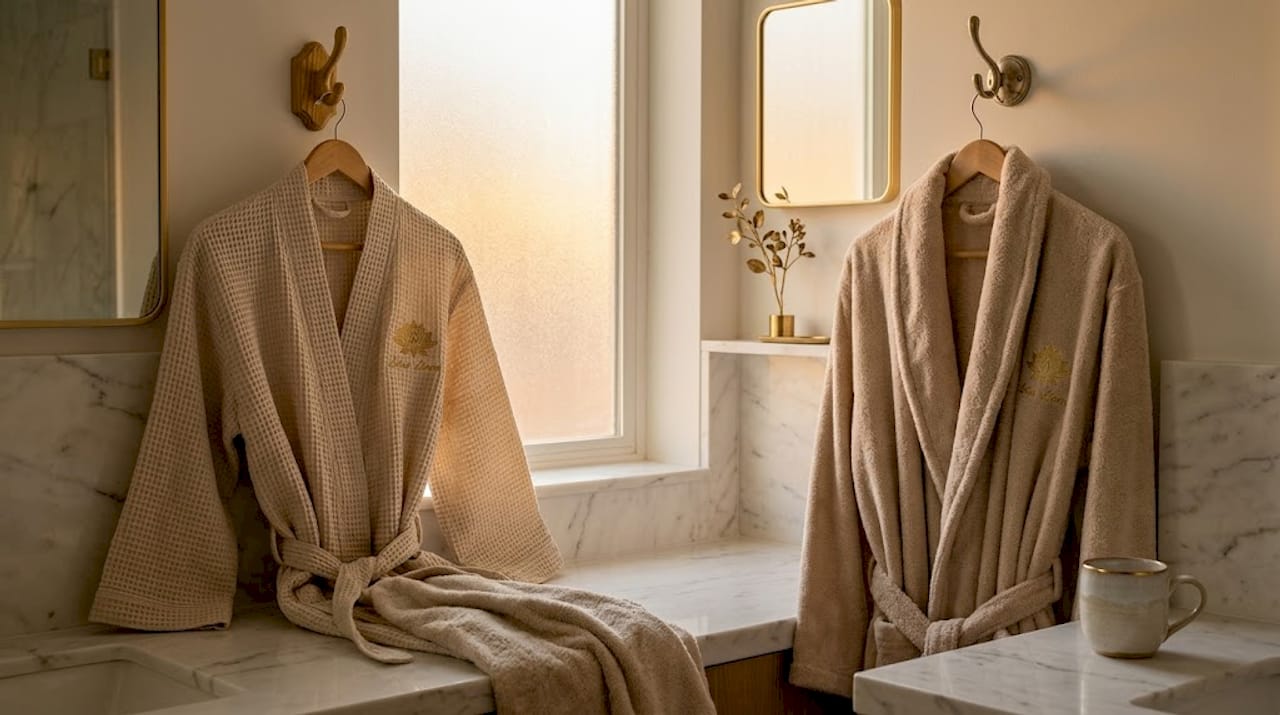
GSM (grams per square meter) is the key number to track. The optimal GSM range for terry robes sits between 400 and 600, while waffle weave works best between 200 and 350. Anything above 600 GSM starts to behave more like a weighted blanket when damp, dragging on the body and taking hours to dry fully.
Natural fibers vs. synthetics
| Fabric | GSM Range | Breathability | Moisture Management | Best Climate |
|---|---|---|---|---|
| Cotton terry | 400–600 | Moderate | High absorption, slow release | Cool to neutral |
| Waffle cotton | 200–350 | High | Fast release, quick drying | Warm to hot |
| Bamboo | 300–500 | High | Excellent wicking, soft | Humid and warm |
| Merino wool | 300–450 | Moderate | Natural temperature buffer | Cold or variable |
| Microfiber | 200–350 | Low | Fast drying, poor breathability | Neutral (short use) |
| Plush/chenille | 500–700 | Low | Absorbs heavily, dries slowly | Cold, short term use |
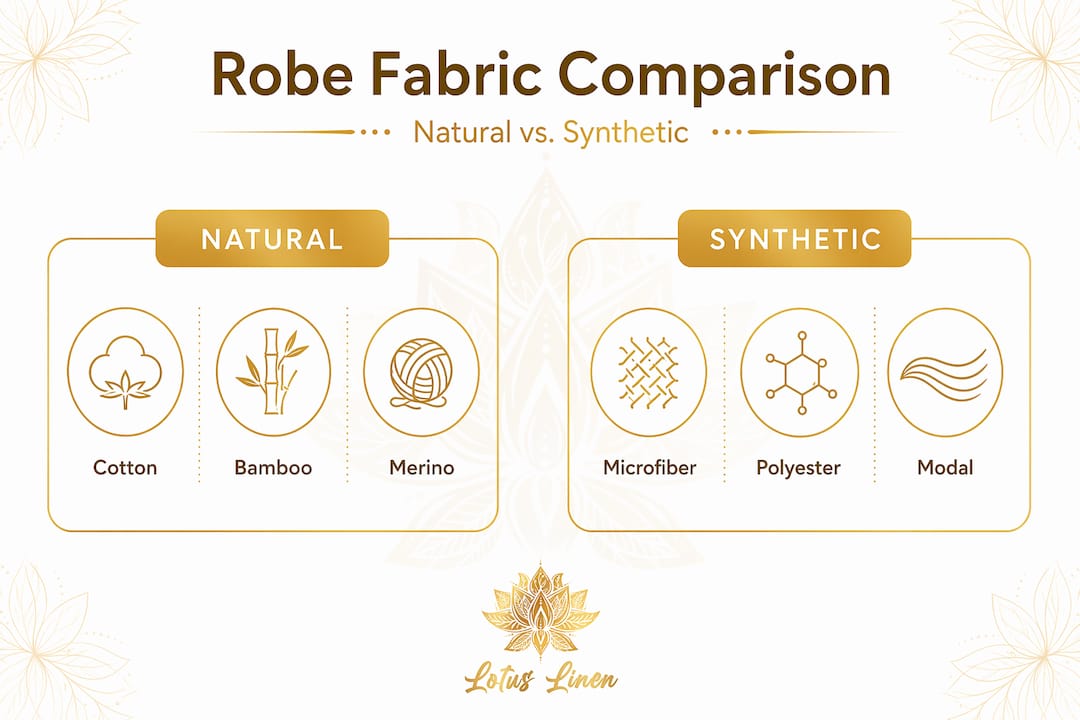
Bamboo fabric stands out in this comparison. Its fiber structure moves moisture away from the skin quickly, and it has a natural thermoregulating quality that makes it genuinely functional across a wider temperature range than cotton alone. You can read more about robe fabrics for hot climates if warm or humid environments are your primary concern.
Merino wool is underused in robes. It buffers temperature shifts naturally, keeping you warm in a cold bathroom and preventing overheating when the room warms up. Its moisture-wicking properties mean it does not cling to damp skin the way cotton does after a prolonged soak.
Pro Tip: For anyone who experiences night sweats or fluctuates between feeling cold and warm, a lightweight bamboo or merino wool robe will outperform a plush cotton option every time. The goal is moisture transport speed, not absorption volume.
Innovations in robe textiles you should know about
The most significant shift in temperature regulating sleepwear and loungewear is happening at the fiber and coating level, not in design or thickness.
Radiative cooling fabrics are among the most exciting developments. These textiles are coated with TiO₂ and SiO₂ nanoparticles that reflect solar energy while simultaneously emitting the body’s heat outward as infrared radiation. In controlled testing, these coatings deliver up to 6.9°C cooling compared to standard cotton under direct sunlight. What makes them practical is that they maintain solar reflectivity above 92% even while the wearer is perspiring, which is where most cooling fabrics fail.
Evaporative cooling research adds another dimension. Studies on garment structure confirm that approximately 80% of cooling variation across different garment designs is governed by how effectively water evaporates from the fabric. Airflow velocity and humidity levels directly impact that number. A robe with excellent evaporative design worn in a stagnant, humid bathroom will still underperform. Context matters.
Some of the most promising textiles pair directional microstructures with advanced coatings. These constructions actively shed sweat away from the inner surface while preserving the spectral properties that allow passive cooling in hot conditions. In practical terms, these fabrics stay cooler than standard cotton even during light physical activity.
For everyday robe wear, the implications are straightforward. You do not need a lab-grade garment. But choosing fabrics that prioritize permeability, moisture transport, and structural airflow gives you the same directional benefits at a practical scale. Explore thermal bathrobe features for more detail on how these principles translate into consumer robe design.
How to choose the right robe for your climate
Selecting a robe based purely on aesthetics or brand name is one of the most common buying mistakes. Here is a practical framework based on climate and comfort priorities.
-
Hot and humid environments: Prioritize waffle weave cotton or bamboo robes in the 200 to 350 GSM range. You want open structure and fast moisture release over any insulating quality. Cooling robes for summer use should feel almost like a light shirt, not a wrap.
-
Cold environments: Plush or sherpa-lined robes in the 500 to 600 GSM range deliver the insulated warmth you need. Keep the wear period short and avoid sleeping in them. Plush robes improve pre-sleep comfort but are not designed for overnight wear due to overheating risk.
-
Variable or transitional climates: Merino wool or dual-layer bamboo robes with moderate GSM around 400 give you the broadest comfort window. They warm up quickly in cool air and release moisture effectively when the environment shifts.
-
Spa or post-exercise use: Terry cloth in the 400 to 500 GSM range absorbs moisture well in these short-burst contexts. Avoid anything above 600 GSM since heavier robes above 600 GSM stay uncomfortably damp and impede comfort.
-
Sleep hygiene routines: Sleep researchers note that robes signal environmental cues for sleep, helping lower ambient room temperature while keeping you warm before bed. A medium-weight cotton or bamboo robe serves this purpose well without overheating you during the transition.
The breathable bathrobe materials guide at Shoplotuslinen breaks down specific fiber comparisons if you want to go deeper on material selection before buying.
Pro Tip: When shopping online, check both GSM and fiber type together. A 450 GSM bamboo robe and a 450 GSM microfiber robe are not comparable in comfort or breathability, even though the weight number is identical.
Keeping your robe’s performance intact
How you care for a robe directly impacts how long it maintains its thermal and moisture-management properties. A few consistent habits protect the fabric structure over years of use.
- Wash cotton terry and waffle robes in warm water (not hot) to preserve loop structure and prevent shrinkage. Hot water flattens pile over time, reducing the air-trapping ability that makes terry cloth effective.
- Use a gentle, fragrance-free detergent for bamboo or merino wool robes. Harsh surfactants strip the natural fiber coatings that give these fabrics their wicking properties.
- Avoid fabric softeners on any performance-oriented robe. Softeners coat fibers with a residue that blocks moisture absorption and airflow, which is exactly what you do not want.
- Tumble dry on low heat or air dry flat for robes above 500 GSM. High heat causes fiber degradation in plush and chenille constructions.
- Store robes loosely hung rather than folded tightly. Compression collapses the loft of plush and terry fabrics, reducing their insulating and airflow properties over time.
- For robes with advanced coatings or microstructured textiles, follow manufacturer instructions precisely. High heat and aggressive washing cycles can degrade nanoparticle coatings after repeated cycles.
My honest take on robe selection
I’ve seen customers walk away from a perfectly functional waffle robe because it “didn’t feel substantial enough” in their hands, then complain about sweating through a 650 GSM plush robe two weeks later. The weight bias in robe shopping is deeply ingrained, and it costs people real comfort.
In my experience, the buyers who are happiest with their robes are the ones who think about their actual use case. Not what looks luxurious. Not what matches the bathroom decor. They ask: how warm is my house in the morning? Do I run hot or cold? Am I wearing this for five minutes after a shower or wrapping up for an hour with coffee?
The radiative cooling research genuinely impressed me when I first encountered it. A fabric that reflects heat passively without any battery or active cooling mechanism sounds almost implausible. But the physics are real, and the practical benefits for anyone living in a warm climate or dealing with menopause-related temperature swings are significant. I don’t think we’re years away from seeing these textiles in consumer robes at reasonable prices.
What I’ve also found is that robe buyers consistently underestimate how much room conditions matter. A 400 GSM cotton robe in a 68°F bathroom feels entirely different than the same robe in a 78°F bathroom with post-shower humidity. The robe didn’t change. The environment did. Before you blame the robe, check the room.
My practical advice: choose based on fabric structure and GSM first, then let aesthetics follow. A beautiful robe that makes you sweat is not comfortable, regardless of how it looks on a hanger.
— Oguzhan
The right robe for your thermal comfort, from Shoplotuslinen
At Shoplotuslinen, we built our robe collections around the principles covered in this guide. Not marketing language. Actual fabric choices that reflect what we know about thermal control in robes and how your body actually experiences warmth and breathability.
If you run warm or live somewhere humid, our men’s waffle robes are designed for maximum airflow with the fast-drying properties that make waffle weave the right choice for daily use. If you prioritize warmth and cozy comfort in cooler months, our plush robe collection delivers insulated softness without compromising on quality or durability. We offer options for men, women, kids, and families, with customization available across the range. Browse by fabric and climate need to find the robe that works for your body, not just your bathroom shelf.
FAQ
What fabric regulates temperature best in a robe?
Bamboo and merino wool regulate temperature most effectively across varying conditions. Both wick moisture efficiently and adapt to ambient temperature shifts better than standard cotton terry.
Is a heavier robe always warmer?
No. Robes above 600 GSM can trap humid air and moisture against the skin, making you feel clammy rather than warm. Weight and warmth are not the same thing in robe fabrics.
How do waffle robes compare to terry robes for breathability?
Waffle robes have an open-grid construction that allows significantly more airflow than terry pile. They also weigh less and dry faster, making them the better choice for warm climates or active use.
Can robes help with sleep temperature regulation?
Yes. Research supports using robes as part of a pre-sleep routine to signal the body toward rest while allowing the room to stay cooler. Lightweight cotton or bamboo robes work best for this purpose, as plush robes carry overheating risk during extended wear.
What GSM should I look for in a breathable robe?
For breathability, look for robes in the 200 to 350 GSM range in waffle weave or 300 to 450 GSM in bamboo fabric. These weights allow moisture release and airflow without sacrificing all warmth.

