
TL;DR:
- Customized robes serve as vital brand touchpoints, communicating a hotel’s identity through fabric, design, and personalization. They influence guest mood and memory, supporting differentiation and generating revenue through structured upgrade offers. Operational durability and strategic presentation ensure robes remain a valuable asset for lasting guest impressions.
Customized robes are defined as branded textile touchpoints that communicate a hotel’s identity through fabric, design, and personalization at the moment guests feel most relaxed and receptive. The role of customized robes in hotel identity goes far beyond a folded garment on a bed. A robe carries your color palette, your logo, your texture philosophy, and your service promise into the most intimate space a guest occupies. Research from Amadeus confirms that 74% of travelers desire personalization, and branded comfort items like robes rank among the top revenue-generating amenities. This guide covers how robes reinforce brand identity, what customization options exist, how operational performance sustains that identity, and how to integrate robes into a guest experience that guests remember and return for.
How do customized robes reinforce a hotel’s brand identity?
A robe reinforces brand identity through four simultaneous channels: visual design, tactile sensation, emotional association, and memory. When all four align with your hotel’s story, the robe stops being an amenity and starts being a brand statement.
Logo and monogram placement
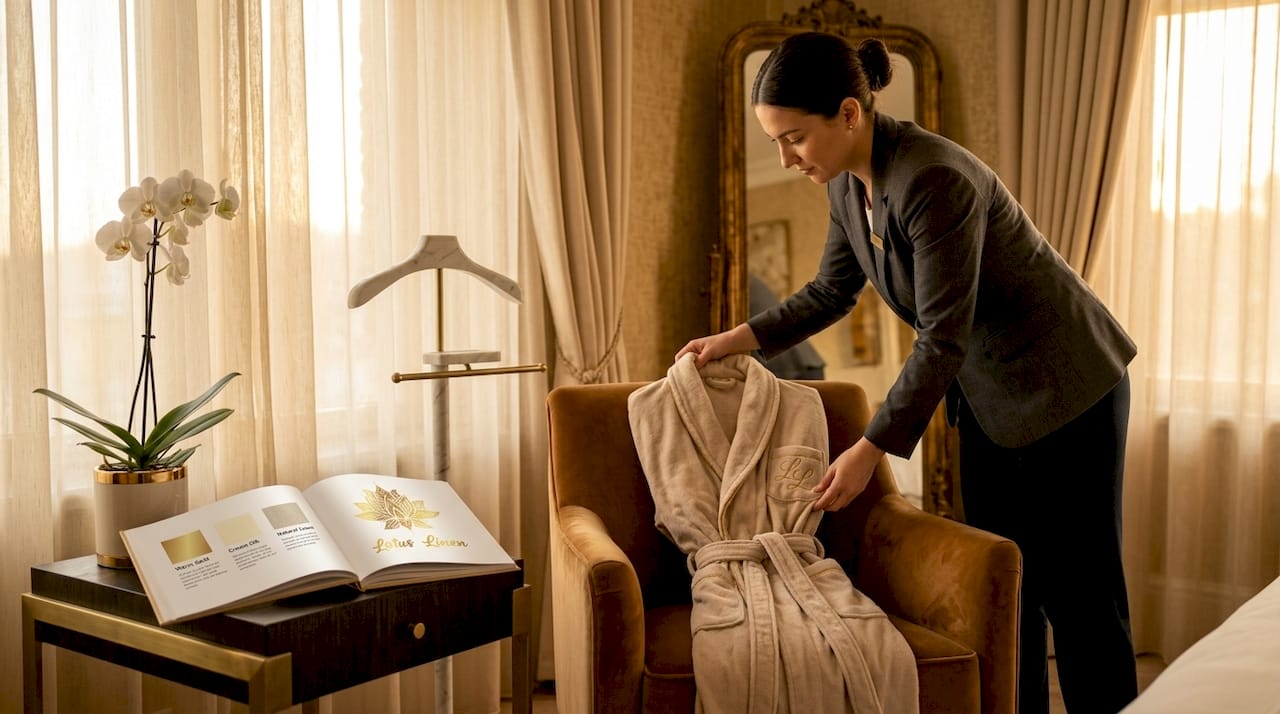
Logo placement on a robe works best when it is subtle yet unmistakable. A chest-embroidered monogram in a tonal thread color, or a woven label at the collar in your brand font, creates what hospitality branding specialists at JDNCO describe as a “quiet but inescapable” brand presence. Guests notice it without feeling marketed to. That distinction matters enormously in luxury hospitality, where overt selling destroys the mood you have spent thousands of dollars creating.
Color palette and fabric as brand language
Your robe’s color and fabric weight should map directly to your brand personality. A coastal boutique property might choose a lightweight waffle weave in natural ivory to echo the texture of sea grass and sand. A mountain lodge communicates warmth and substance through a deep charcoal plush robe with a heavier GSM. La Gemma Hotel integrates plush bathrobes alongside curated in-room amenities to reinforce a cohesive Italian luxury identity. The robe is not a standalone item there. It is one thread in a deliberate sensory narrative.
Sensory impact on mood and memory
Ranjit Bindra of Bastian Hospitality argues that luxury today is about emotion, not excess. This means design shapes mood, behavior, and memory. A robe that wraps a guest in the right weight and texture at the right moment creates a physical memory of your property. That memory is what drives repeat bookings and word-of-mouth referrals more reliably than any loyalty points program.
Pro Tip: Embroider your logo in a thread color that is one shade darker than the robe fabric. The result reads as intentional and refined rather than promotional, which aligns with how guests in the luxury segment respond to branding.
What customization options support boutique hotel differentiation?
Robe customization options fall into four categories: decoration method, fabric selection, personalization depth, and presentation. Each choice either reinforces or dilutes your brand story.
Decoration methods compared
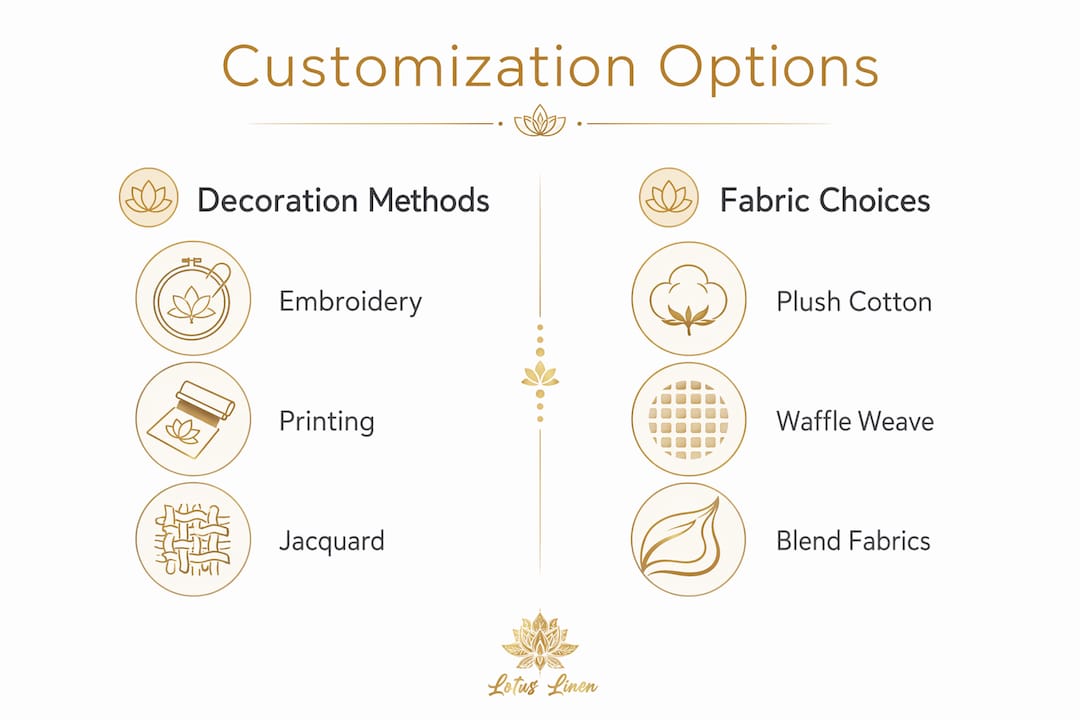
The two primary decoration methods are embroidery and printing. Embroidery produces a raised, textured finish that survives repeated industrial laundering without fading or cracking. Printing, including heat transfer and screen printing, costs less upfront but degrades faster under the high-temperature wash cycles common in hotel operations. For boutique hotels investing in robe customization as a long-term brand asset, embroidery is the operationally sound choice.
| Customization method | Best for | Durability | Cost |
|---|---|---|---|
| Embroidery | Logos, monograms, crests | High (100+ washes) | Medium to high |
| Heat transfer printing | Complex graphics, photography | Low to medium | Low |
| Woven labels | Brand tags, care instructions | Very high | Low to medium |
| Jacquard weave | Subtle all-over patterns | Very high | High |
Fabric selection for brand and operations
Fabric choice is where brand identity and operational reality intersect. Plush robes in 400 to 500 GSM cotton communicate spa-worthy indulgence and suit cooler climates or spa-focused properties. Waffle robes in 250 to 300 GSM are breathable, dry faster between guest stays, and work well in warm-weather destinations or properties with high turnover. Blended fabrics, such as cotton-polyester mixes, offer shrinkage resistance that pure cotton cannot match under daily laundering. Understanding laundering frequency and its effect on fabric integrity should inform your fabric decision before you finalize a design.
Personalization beyond the logo
Personalization options now extend well past a property logo. Guest name monogramming, available as a pre-arrival add-on, transforms a robe into a keepsake. Style variants, such as offering a kimono cut alongside a traditional shawl collar, allow guests to choose based on preference. Color variants tied to room category or suite tier create a tiered luxury signal without requiring a complete redesign. Packaging matters too. A robe presented in a branded cotton bag with a handwritten card and a scent sachet becomes a curated welcome ritual rather than a standard amenity.
How do operational factors affect robe branding over time?
Brand identity expressed through a robe on day one means nothing if that robe looks worn and faded by month three. Operational performance is the silent partner of every customization decision.
The NAUMD Image of the Year Award program evaluates hospitality uniform programs on both visual brand alignment and apparel performance including durability, fade resistance, and wearer satisfaction. Award-winning programs treat these as equally weighted criteria, not as a hierarchy where aesthetics come first. That framing applies directly to robes.
Four Seasons Resort Nevis redesigned its uniform program with tropical laundering durability as a core requirement, not an afterthought. The result was a refreshed, consistent brand expression that held up under the humidity and high-frequency washing cycles of a Caribbean resort environment. The lesson for hoteliers is direct: your robe supplier must understand your laundry operation before they recommend a fabric or decoration method.
Key operational factors to address before finalizing a robe program:
- Shrinkage tolerance: Specify maximum allowable shrinkage after 50 industrial wash cycles. A robe that shrinks 5% becomes uncomfortable and looks cheap.
- Fade resistance: Embroidery thread and fabric dye should be tested together, since thread can retain color while the base fabric fades, creating a mismatched appearance.
- Laundering temperature compatibility: Confirm that your decoration method survives the temperatures your housekeeping team uses.
- Wearer comfort under repeated use: A robe that pills or loses its hand feel after 20 washes signals poor quality to guests, regardless of how good the logo looks.
Pro Tip: Request a laundering test sample from your supplier before placing a bulk order. Run it through your actual laundry protocol 30 times and evaluate the result. This single step prevents the most common and costly robe program failures.
Involving your housekeeping and laundry operations managers early in the selection process also surfaces constraints that purchasing teams often miss. They know which fabric finishes survive your specific machines and water chemistry. That knowledge protects your brand investment.
What strategies integrate robes into an immersive guest experience?
Robes function best as part of an in-room identity narrative that incorporates design language, sensory elements, and curated personal amenities. A robe placed on a hanger next to coordinated slippers, a scented candle in your brand fragrance, and a room card written in your brand voice creates a unified sensory experience that guests feel before they consciously register it.
Here is a practical framework for integrating robes into your guest experience system:
- Anchor the robe to your room design language. If your rooms use natural linen textures and warm wood tones, your robe fabric and color should echo those choices. Guests notice coherence even when they cannot name it.
- Create a structured personalization offer. Present guests with a clear pre-arrival choice: standard robe, monogrammed robe, or a premium robe upgrade with scent pairing. Amadeus research shows that structured personalization offers can generate over $1 million annually for a mid-scale property. The key is presenting the choice clearly, not burying it in a long amenities list.
- Coordinate robe presentation with arrival timing. A robe laid out on the bed differs from one hanging in a wardrobe with a card explaining its fabric and origin. The latter communicates intentionality and invites the guest to engage with it.
- Use the robe as a storytelling vehicle. A small card attached to the robe that explains your fabric choice, your embroidery process, or your sustainability commitment turns a garment into a conversation. Boutique hotel guests, in particular, respond to provenance and craft.
- Offer robes as purchasable keepsakes. Guests who love a robe will buy it if you make the process frictionless. A QR code on the care label linking to your online store or a wholesale partner page closes that loop without requiring front desk involvement.
| Integration strategy | Guest benefit | Revenue potential |
|---|---|---|
| Pre-arrival monogram add-on | Personal connection, keepsake value | Direct upsell revenue |
| Robe and scent pairing package | Multisensory brand memory | Package pricing premium |
| Purchasable robe program | Brand extension, loyalty signal | Retail margin |
| Tiered robe by room category | Perceived value differentiation | Supports rate strategy |
Key takeaways
Customized robes are a measurable brand investment that shapes guest perception, supports operational consistency, and generates direct revenue when integrated with a structured personalization strategy.
| Point | Details |
|---|---|
| Robes communicate brand identity | Fabric, color, and logo placement work together to create a coherent sensory brand signal. |
| Embroidery outperforms printing | Embroidered decoration survives industrial laundering far better, protecting your brand investment long-term. |
| Operations must inform design | Shrinkage, fade resistance, and laundering compatibility should be tested before bulk orders are placed. |
| Personalization drives revenue | Structured robe upgrade offers can generate significant ancillary revenue, as Amadeus data confirms. |
| Coherence amplifies impact | Robes work best when coordinated with room design, scent, and arrival presentation as a unified experience. |
Why robes are the most underestimated brand asset in hospitality
I have worked with hotel buyers who spend months deliberating over lobby furniture and approve a robe program in fifteen minutes. That inversion of attention is the single most common mistake I see in hospitality branding. The lobby impresses guests for thirty seconds. The robe is with them for hours.
What I have learned from working with hospitality clients at Shoplotuslinen is that the properties with the strongest robe programs share one trait: they treat the robe as a brand document, not a commodity purchase. They ask the same questions about a robe that they ask about a logo redesign. What does this say about us? How does it feel? Will it hold up to scrutiny over time?
The operational complexity is also consistently underestimated. I have seen beautiful embroidered robes arrive at a property and look degraded within two months because nobody tested them against the laundry protocol. That failure is not a textile failure. It is a process failure, and it is entirely preventable.
The trend I find most significant right now is the shift toward what Bastian Hospitality’s Ranjit Bindra calls emotional luxury. Guests are not impressed by thread counts they cannot verify. They are moved by the feeling that someone thought carefully about their experience. A robe that fits well, feels spa-worthy, and carries a subtle mark of the property’s identity delivers exactly that feeling. It is one of the few amenities that costs less than a minibar and creates more loyalty than a points program.
My advice to any hotelier reading this: treat your next robe program as a brand brief, not a procurement exercise. Involve your designer, your operations team, and your front-of-house staff in the decision. The result will be a robe that guests photograph, talk about, and try to take home. That is the kind of brand impression no advertising budget can replicate.
— Oguzhan
Spa-worthy customized robes for your property, from Shoplotuslinen
Shoplotuslinen designs and produces spa-worthy plush and waffle robes with in-house embroidery from Santa Ana, CA, built specifically for boutique hotels and luxury properties that take their brand identity seriously. Every robe is tested for laundering durability and fade resistance before it ships, so the brand experience you design on day one holds up through hundreds of guest stays.
Explore personalized robes for men with custom monogramming and logo embroidery, or pair your robe program with Shoplotuslinen’s scallop piping bath towels for a fully coordinated in-room identity. For bulk orders and wholesale pricing tailored to your property’s needs, visit the wholesale program page to start a conversation with the Shoplotuslinen team.
FAQ
What is the role of customized robes in hotel identity?
Customized robes serve as branded textile touchpoints that communicate a hotel’s identity through fabric choice, color, logo placement, and personalization. They shape guest mood and memory during the most intimate moments of a stay, reinforcing brand perception more durably than most other in-room amenities.
How do robes support boutique hotel differentiation?
Boutique hotels use robes to express a specific design narrative that larger chain properties cannot replicate at scale. Fabric selection, monogram style, and coordinated presentation create a sensory signature that guests associate exclusively with that property.
What customization options are available for hotel robes?
The primary options are embroidery, woven labels, jacquard weave patterns, and heat transfer printing, combined with choices in fabric weight, cut, color, and guest-name personalization. Embroidery is the most durable option for hotel operations and the most aligned with luxury brand standards.
How do I choose between plush and waffle robes for my property?
Plush robes in 400 to 500 GSM cotton suit spa-focused or cooler-climate properties where indulgence is the primary brand message. Waffle robes are lighter, dry faster between stays, and work better in warm-weather destinations or properties with high room turnover.
Can customized robes generate direct revenue for hotels?
Yes. Amadeus research shows that personalized amenity programs including branded robes can generate over $1 million annually for a mid-scale property when structured as clear guest upgrade choices at booking or check-in.

