
TL;DR: Effective bath linen inventory management combines sensible par levels, a layered audit routine, and clear chain-of-custody handoffs. The goal is not zero loss — it is a system that catches drift early and tells you where losses are happening so you can fix the cause.
Bath linen inventory tracking is the systematic process of monitoring and managing linen stock to minimize loss, keep enough sets in circulation, and improve day-to-day efficiency. For any hospitality operation, untracked linen is a direct cost — towels and robes disappear a few at a time until reorders quietly balloon. The right approach combines disciplined par levels, regular audits, and simple accountability at each handoff. This guide walks through the practical building blocks.
Tools for bath linen inventory tracking
The industry term for this practice is linen inventory management, and it spans everything from daily towel counts to scanning linens at laundry checkpoints. Tracking is the layer that makes it work in real time.
Manual tracking
Manual tracking relies on daily counts, written logs, and periodic physical audits. Staff record linen quantities at each handoff point — storage rooms, laundry carts, and guest rooms. It costs nothing to implement, but it is labor-intensive and prone to counting errors, especially at larger properties where a small percentage of miscounts adds up to a meaningful gap in the numbers.

RFID technology
RFID (radio frequency identification) is a technology option for larger operations. Each linen item receives a small embedded tag, and fixed or handheld scanners read those tags at checkpoints such as the loading dock, laundry chutes, and storage entry points. RFID tags are designed to survive industrial laundering, and compared with manual counting they can improve accuracy and dramatically speed up audits. The trade-off is a real upfront cost for tags and readers, so RFID tends to make sense once a property's linen inventory and volume are large enough to justify the investment.
Manual vs. RFID at a glance
| Feature | Manual tracking | RFID tracking |
|---|---|---|
| Accuracy | Lower; depends on staff diligence | Higher; automated reads |
| Audit time | High (hours per count) | Much faster |
| Loss detection | Reactive | Closer to real-time |
| Upfront cost | Low | Higher (tags + readers) |
| Best for | Small properties | Mid to large properties |
Pro tip: If full RFID is outside your budget, start by tagging your highest-value items first — spa robes and premium bath towels — then expand as the system proves out.
How to set par levels for bath linens
Par levels define the minimum quantity of each linen type you must have available at all times to operate without interruption. Setting them correctly is the foundation of any linen inventory system.
The three-par rule
A common hospitality starting point is the three-par rule: maintain three full sets of linen for every occupied unit — one in use with the guest, one in the laundry cycle, and one clean and ready for the next turnover. Some properties increase this to four or five sets during peak occupancy to absorb laundry delays without running short.
Step-by-step par calculation
- Count your occupied units. Start with the number of rooms or suites at full capacity.
- Multiply by items per unit. A standard room might use two bath towels, one hand towel, and one washcloth per guest per night.
- Apply the three-par multiplier. Multiply items per unit by three to get your baseline par.
- Add a buffer for laundry turnaround. If your laundry cycle takes a day, add an extra set per unit to cover the gap.
- Adjust for peak periods. Base par on peak occupancy plus a buffer, not just average turnover — a resort at high summer occupancy needs a different par than the same property in a slow month.
As an illustration, for a 100-room property using two bath towels per room: 100 rooms × 2 towels × 3 sets = 600 bath towels as a baseline par. Add another set per room for a one-day laundry buffer and your operational par lands around 800 towels.
Pro tip: Review par levels every quarter. Seasonal swings, renovation closures, and group bookings all shift your real needs. A par level set on opening day is almost always wrong by year two.
Best practices for a bath linen audit
A bath linen audit is a structured count and reconciliation of all linen in circulation. Effective tracking uses daily logs, laundry checks, and monthly physical counts — each layer catches a different type of loss.
A three-tier audit schedule
- Daily counts. Housekeeping records linen quantities at the start and end of each shift, catching same-day discrepancies before they compound.
- Weekly reconciliation. Compare laundry returns against what was sent out. A weight check adds a fast cross-reference: if far less comes back than went out, something is missing.
- Monthly physical inventory. Count every item across all locations — storage, laundry, guest rooms, and staff areas. This is your ground-truth number for ordering.
Chain of custody and sealed bundles
One of the most effective loss-control techniques is issuing linens in sealed bundles signed out by staff. Each bundle holds a fixed count, and whoever signs it out is accountable for returning that count. This creates a clear audit trail and reveals where losses actually occur, instead of letting shrinkage disappear into a vague "unknown loss" category. Integrating linen counts with a property management system (PMS) adds another checkpoint: when a room's status changes from occupied to vacant, the system can prompt a linen verification before turnover.
Pro tip: Scan or count linens at every transition point, not just at storage. A check at the laundry chute and another at the clean-linen shelf creates two-point verification that catches losses in the laundry process — one of the most common loss zones.
Common mistakes to avoid:
- Counting only at month-end and missing daily drift
- Relying on laundry-vendor counts without independent verification
- Skipping guest-room counts during audits
- Failing to log damaged or retired items separately from losses
How tracking reduces loss and cuts costs
Accurate tracking pays off in fewer surprise reorders and better-controlled inventory. Beyond catching losses, real-time visibility lets purchasing order based on actual depletion rather than guesswork, and it helps you avoid overstocking — excess linens sitting in storage tie up capital you could use elsewhere.
Shrinkage includes theft, improper disposal, and misplacement. Tracking helps you identify which category is driving your losses: a property losing towels mainly to guest removal needs a different response than one losing them to laundry misrouting. Data tells you which problem you actually have.
Standardizing linen specifications also reduces cost across multi-property operations. When every property uses the same towel dimensions, weights, and weave, purchasing consolidates, staff training simplifies, and your tracking system carries fewer SKUs. Standardization is one of the most overlooked levers in linen control. Tracking wash history also lets you retire linens before they visibly degrade in guest rooms, protecting the guest experience and reducing emergency reorders.
Pitfalls to avoid in linen tracking
The most common failure is treating bath linen management as a housekeeping chore rather than an operational system. Specific pitfalls:
- Static par levels. Par based on average occupancy fails during peak periods. Build in seasonal buffers.
- Ignoring internal loss. Staff misplacement and improper disposal account for a real share of shrinkage. Sealed bundles and movement logs address this directly.
- Skipping the audit trail. Without signed handoffs and logged movements, you can only count what is missing — not find where it went.
- Underinvesting in training. A tracking system is only as accurate as the people running it. Staff who understand why counts matter produce better data.
Pro tip: Use structured linen storage organized by category and quantity. When storage is orderly, daily counts take less time and discrepancies are easier to spot.
Key takeaways
| Point | Details |
|---|---|
| Match the method to the property | Manual counting suits small properties; RFID earns its cost at larger ones. |
| Three-par as a baseline | Three full sets per unit: one in use, one in laundry, one ready. |
| Layer your audits | Daily logs, weekly reconciliation, and monthly counts each catch different loss types. |
| Sealed bundles reduce shrinkage | Signed handoffs create accountability and reveal where losses occur. |
| Standardization cuts cost | Uniform specs simplify tracking, purchasing, and training across properties. |
Why linen loss is usually slow drift, not dramatic theft
A pattern many operators recognize: the property invested in good linens, set a reasonable par at opening, and then never revisited the system. A few years later they are ordering well above what they need because nobody knows where the old towels went. The uncomfortable truth is that most linen loss is not dramatic theft — it is slow, invisible drift. A towel goes home in a guest bag. A robe gets misrouted. A damaged item gets discarded without being logged. None of these feel significant alone; together they add up.
What works is treating linen inventory the way you treat food and beverage: daily counts, signed handoffs, and a clear reorder trigger. Better linens actually make tracking easier, not harder — when you invest in consistent, spa-worthy bath linens with uniform specs, your system has fewer variables to manage. Give your inventory team fewer SKUs and better data, and they will give you fewer surprises at month-end.
How Lotus Linen supports your bath linen program
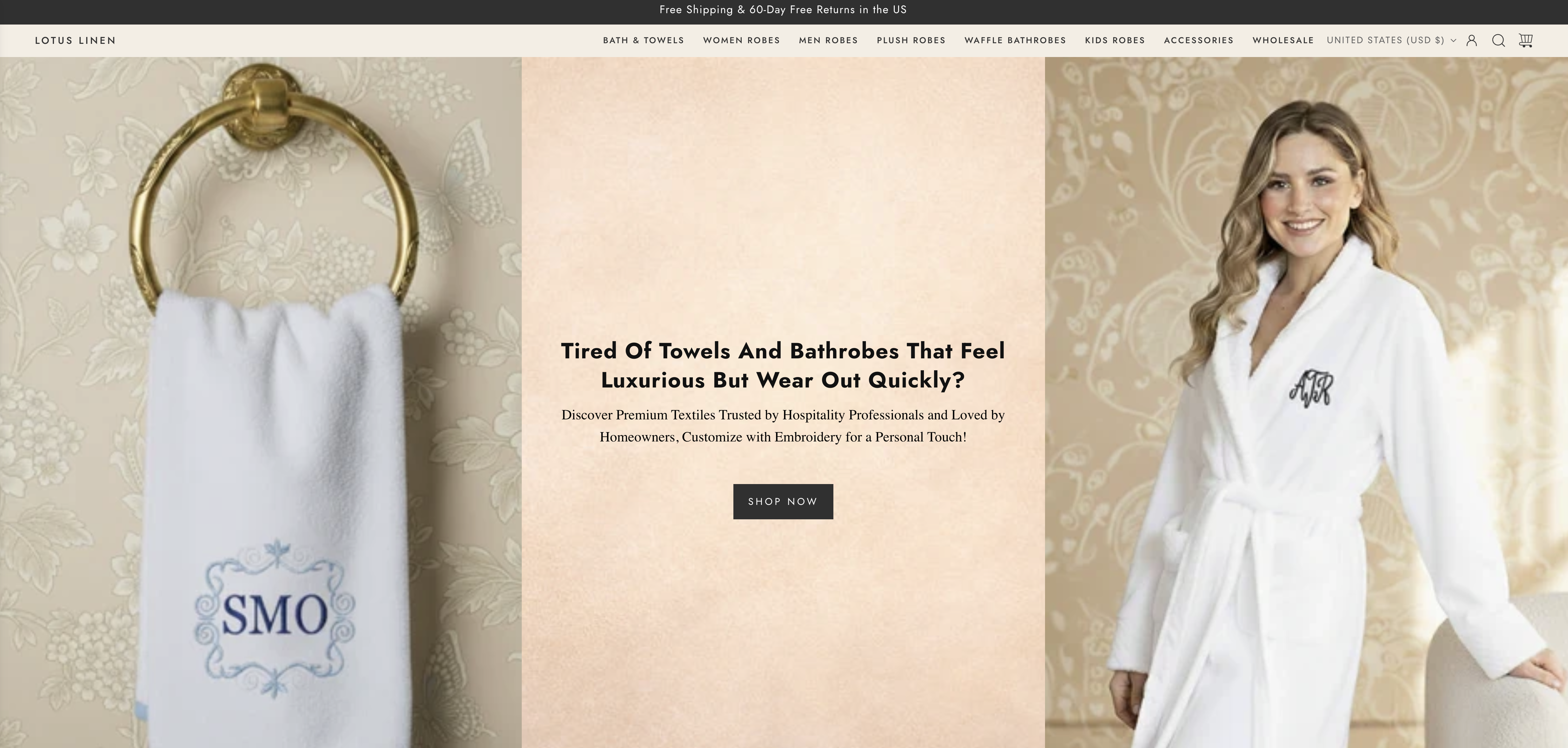
Lotus Linen supplies hospitality businesses with spa-worthy robes, scallop piping cotton towels, and personalized bath accessories built for consistent, trackable inventory. Our scallop piping bath towels are made to uniform dimensions that are easy to standardize across a property, and our plush robes for men and robes for women can be embroidered in-house, which also makes individual items easier to identify. Hospitality buyers can explore our wholesale program for volume pricing and consistent spec sheets that simplify your linen system from day one.
FAQ
What is bath linen inventory tracking?
It is the systematic process of counting, logging, and monitoring bath linens across all locations in a hospitality property to reduce loss and maintain stock levels. It includes daily counts, laundry reconciliation, and periodic physical audits.
How many sets of bath towels does a hotel need per room?
A common starting point is the three-par rule: three full sets per room — one in use, one in laundry, one ready for turnover. Properties with longer laundry cycles or high peak occupancy often increase this to four or five sets.
Does RFID tracking work for bath towels and robes?
RFID tags are designed to be embedded in linens and to survive industrial laundering, so they can be used for towels, robes, and other high-turnover items. Compared with manual counting, RFID can improve accuracy and speed up audits, at a higher upfront cost.
How often should a hotel conduct a linen audit?
A layered routine works best: daily count logs, weekly laundry reconciliation, and a full monthly physical inventory. Each frequency catches a different category of loss.
What causes the most linen loss in hotels?
Loss comes from three main sources: guest removal, staff misplacement, and improper disposal of damaged items. Sealed bundle handoffs and movement logs help identify which source is driving losses at your property.

